
At some point, almost everyone hears about the stock market – on the news, from friends, or while checking how big companies like Reliance or TCS are doing. Many people feel the stock market is complicated or risky and avoid it completely. But the truth is, the stock market plays a role in how companies grow and how ordinary people can participate in that growth. Understanding what the stock market is helps you make sense of investing conversations instead of feeling lost or confused.
But the truth is much simpler.
In this article, we’ll explain what the stock market is, how it works, and why beginners should understand it—in plain, simple language.
What Is the Stock Market?
The stock market is a place where shares of companies are bought and sold.
When a company needs money to grow—expand operations, build products, or enter new markets—it can offer ownership to the public through the process called Initial Public Offering (IPO). This ownership is divided into small parts called shares.
When you buy a share:
- You own a small part of that company
- You participate in its growth (and risks)
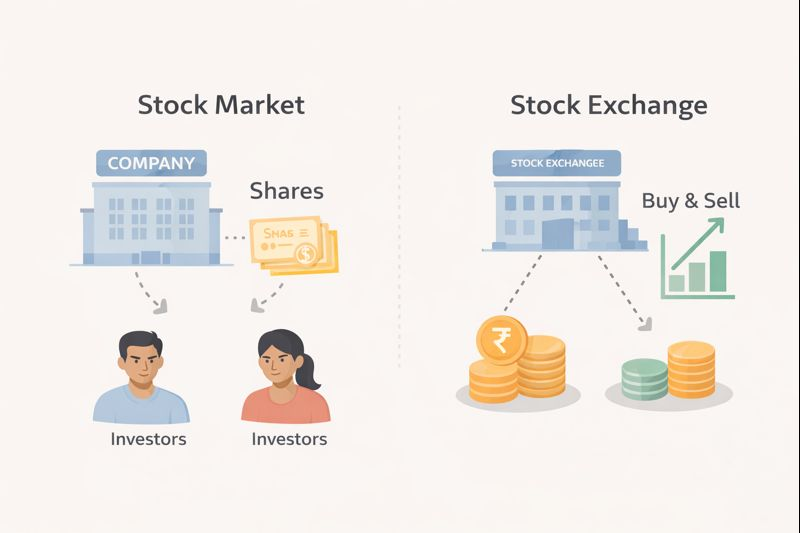
Buying and selling of shares happens through stock exchanges NSE (National Stock Exchange) & BSE (Bombay Stock Exchange). You can buy and sell shares through online apps/brokers on your Demat Account.
The stock market connects:
- Companies that need capital
- Investors who want to grow their money
What Are Shares?
A share represents partial ownership in a company.
For example:
- A company is divided into 1 crore shares
- You buy 10 shares
- You now own a very small part of that company (0.0001% Owner of company)
If the company grows and becomes more valuable:
- Share prices may rise
- Your investment value increases
If the company performs poorly:
- Share prices may fall
That’s why understanding companies and long-term thinking matters. Always research well before investing in any company, Though company may be very good but not fit as per your investment objectives.
Why Do Companies List on the Stock Market?
Companies come to the stock market to:
- Raise money for growth
- Reduce dependence on loans
- Allow early investors to exit partially
- Improve visibility and credibility
In return, companies must:
- Share financial information publicly
- Follow regulations
- Be accountable to shareholders
This transparency helps protect investors.
How Does the Stock Market Work?
The stock market works through stock exchanges NSE (National Stock Exchange) & BSE (Bombay Stock Exchange).
A stock exchange is an organized platform where:
- Buyers place buy orders
- Sellers place sell orders
- Prices are decided based on demand and supply
When more people want to buy a stock than sell:
- Price goes up (High Demand)
When more people want to sell than buy:
- Price goes down (Low Demand)
Prices change constantly based on:
- Company performance
- Economic conditions
- Investor expectations
Stock Market Is Not Just One Place
Many beginners think the stock market is a single entity.
In reality, it includes:
- Multiple stock exchanges
- Thousands of companies
- Millions of investors
Each listed company trades independently based on its own performance and perception.
NSE vs. BSE: Where Do You Trade?
| Feature | BSE (Bombay Stock Exchange) | NSE (National Stock Exchange) |
| Age | The “Old Guard” (Established 1875) | The “Modern Giant” (Established 1992) |
| Main Index | Sensex (Tracks top 30 companies) | Nifty 50 (Tracks top 50 companies) |
| Liquidity | Slightly lower for some small stocks | Very high (easier to buy/sell quickly) |
| Best For | Finding very small, old companies | Day trading and most regular investing |
Is the Stock Market Only for Experts?
No. The stock market is for:
- Beginners
- Salaried professionals
- Long-term investors
- Anyone willing to learn
You don’t need:
- Advanced mathematics
- Daily tracking
- Constant buying and selling
Many successful investors:
- Invest regularly
- Hold investments for years
- Focus on fundamentals, not noise
Although stock market is not just for Experts you still needs to learn investment basics of stock market before you jump into it
Common Myths About the Stock Market
Myth 1: Stock market is gambling
Reality: Gambling depends on luck. Investing depends on research, discipline, and time. It can be considered gambling if you are buying and selling shares basis on rumors, hope and emotions rather than research.
Myth 2: You need a lot of money
Reality: You can start with small amounts. You can even buy 1 share of the company. You need to pay the market price of it.
Myth 3: You must watch the market daily
Reality: Long-term investors rarely need daily monitoring. For a long-term investor, daily news is often just “noise.” Checking your portfolio once a month or once a quarter is usually enough.
Why Stock Markets Go Up and Down
Stock prices move because expectations change.
They react to:
- Company earnings
- Economic news
- Interest rates
- Global events
Short-term movements are often emotional.
Long-term movements usually reflect business growth.
Stock Market vs Real Economy
The stock market is linked to the economy, but they are not the same.
- Economy = jobs, production, spending
- Stock market = expectations of future growth
Sometimes markets fall even when the economy is okay.
Sometimes markets rise even before economic improvement.
Long-term investors focus on business value, not daily headlines.
How Beginners Should Approach the Stock Market
Here’s a simple beginner-friendly approach:
- Learn the basics before investing
- Think long term, not quick profit
- Avoid emotional decisions
- Start small and grow gradually
The goal is participation, not prediction.
Stock Market and Long-Term Wealth
Historically, stock markets have:
- Rewarded patience
- Helped beat inflation
- Created wealth over long periods
But this works best when:
- Investments are diversified
- Time horizon is long
- Expectations are realistic
The stock market is a tool—not a shortcut.
Final Thoughts
The stock market is simply a platform where:
- Businesses grow
- Investors participate in that growth
It is not a casino.
It is not reserved for experts.
It is not about daily wins.
For beginners, understanding how it works is far more important than trying to predict it.
What to Read Next
🔑 Key Takeaway
The stock market connects businesses and investors.
Short-term movements are normal.
Long-term participation builds wealth.