

One of the most confusing moments for a beginner is this:
“The company is good, profits are fine… then why is the stock price falling?”
Many new investors assume a falling price means:
- The company is bad
- Something is wrong
- They made a mistake
In reality, stock prices can fall even when a company is fundamentally very strong.
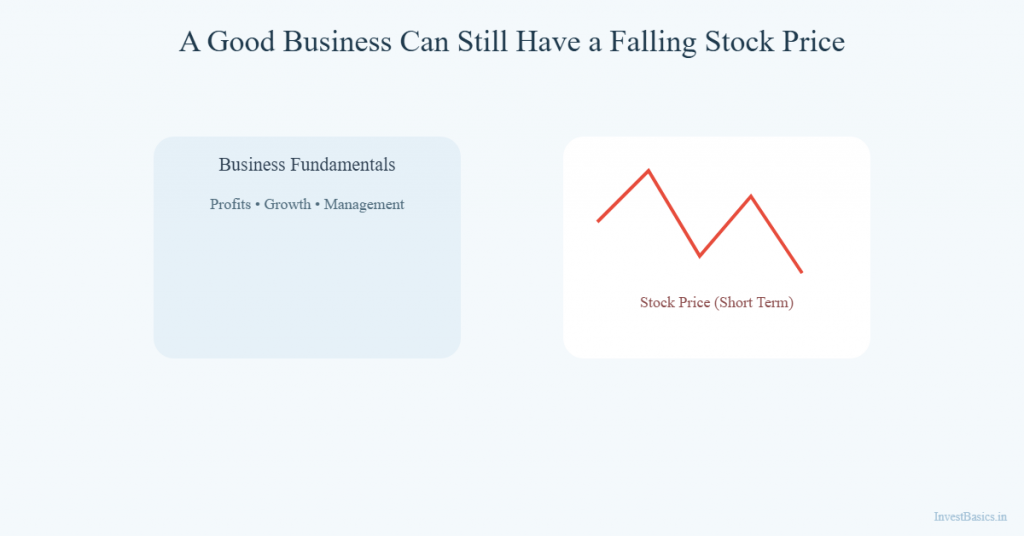
In this article, you’ll learn why this happens, what’s normal, and how beginners should think about falling stock prices—without panic.
First Important Truth: Price ≠ Business
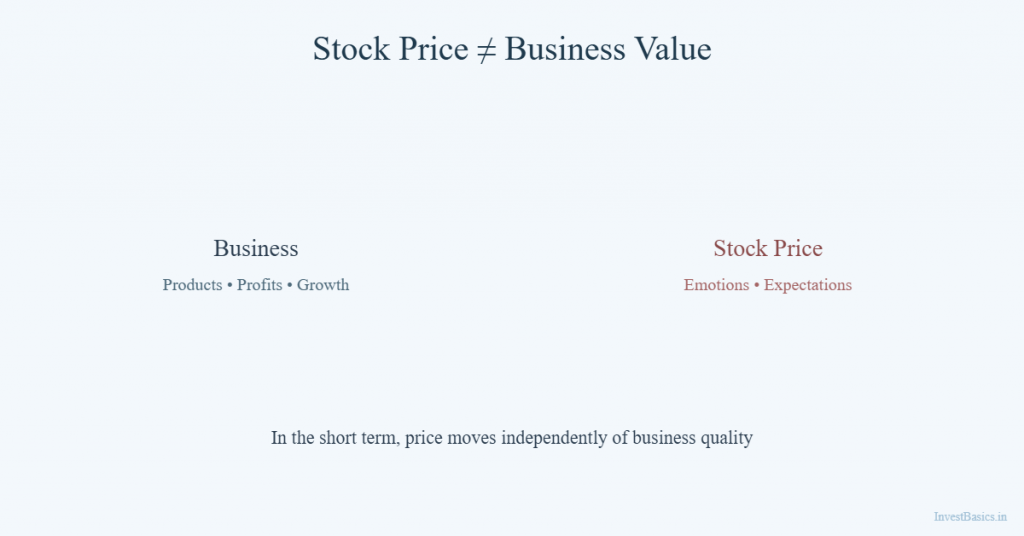
A stock price and a business are not the same thing.
- Business = products, profits, growth, management
- Stock price = what people are willing to pay right now
In the short term, prices are driven by expectations and emotions, not just fundamentals there can be some technical reasons too for the price fall.
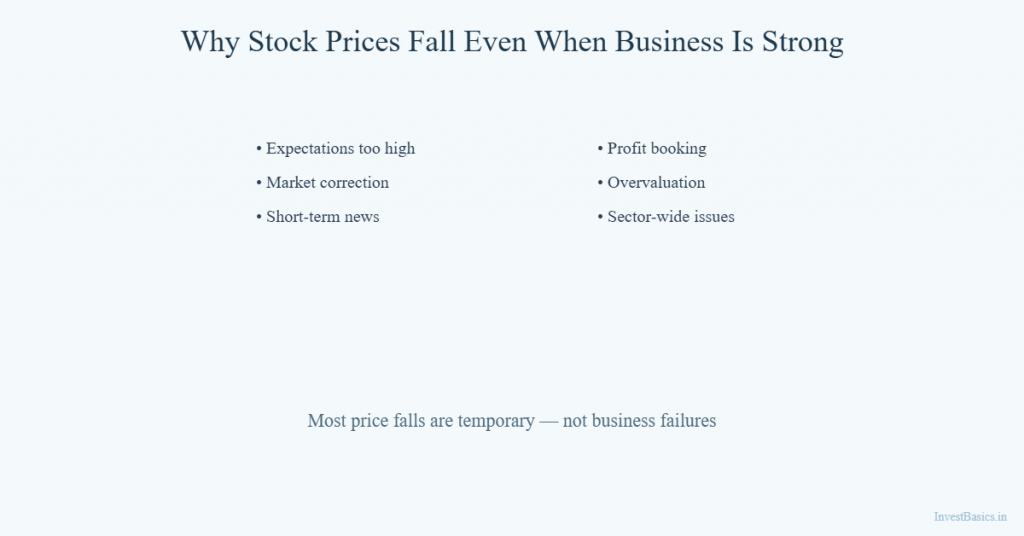
Reason 1: Expectations Were Very High
This is the most common reason.
A company may:
- Deliver good profits
- Grow steadily
But if:
- Investors expected excellent results
- Growth was priced in earlier
Then even “good” results can disappoint.
Example:
- Expected profit growth: 25%
- Actual profit growth: 15%
The business is still growing — but the stock price may fall.
Reason 2: Overall Market Is Falling
Sometimes, prices fall not because of the company, but because of the market.
During:
- Market corrections
- Economic uncertainty
- Global events
Even strong companies fall temporarily because:
- Investors reduce risk
- Money moves to safer assets
This is normal and usually temporary.
Reason 3: Short-Term News or Sentiment
Markets react quickly to news such as:
- Interest rate changes
- Government policies
- Global tensions
- Industry-wide issues
These events may not affect the company long term, but they influence short-term sentiment, causing price drops.
Reason 4: Profit Booking by Investors
When a stock has risen sharply:
- Early investors may sell to lock profits
- Selling pressure increases
- Price falls temporarily
This does not mean that the company is bad and should also exit without any research.
It simply means:
Some investors are taking money off the table. Inshort profit booking.
Reason 5: Valuation Was Too High
A great company can still be a bad investment at the wrong price.
If a stock becomes:
- Overvalued
- Priced far above realistic growth
Then prices may correct even if:
- Profits are rising
- Business is strong
Markets will eventually bring prices closer to fair value and this is called market correction.
You can read this interesting article from clear tax this explain very well how the valuation of a company is calculated
Reason 6: Sector-Wide Issues or Industry Wide
Sometimes, entire sectors face pressure.
Examples:
- IT stocks during global slowdown
- Banking stocks during financial stress
- Pharma stocks due to regulation changes
Even the best companies in a weak sector can fall temporarily.
Short-Term Price Falls vs Long-Term Value
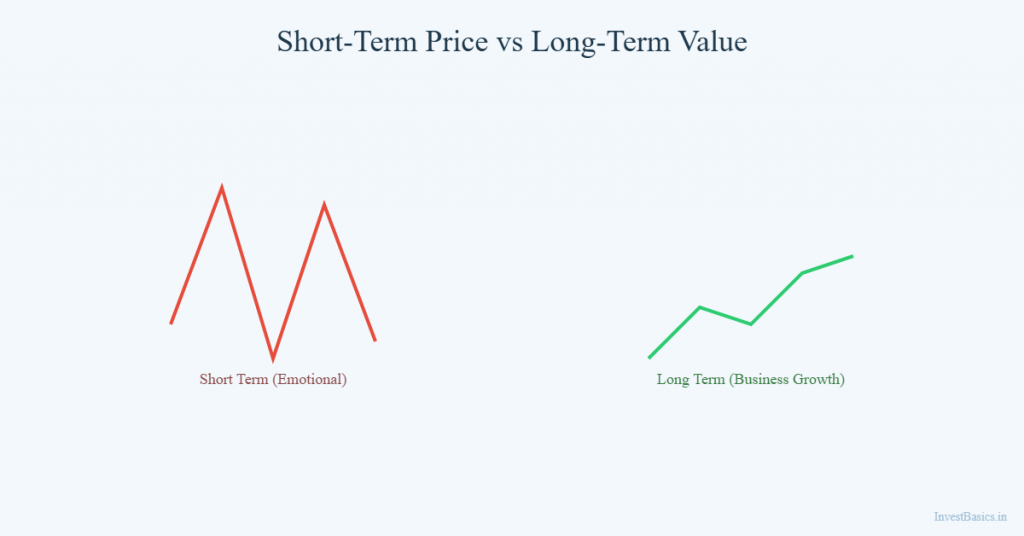
This distinction is critical.
Short Term
- Prices fluctuate
- Emotions dominate
- News drives movement
Long Term
- Business performance matters
- Profits and growth dominate
- Good companies recover and grow
Long-term investors focus on value, they do not case about daily prices.
When Should Beginners Be Concerned?
A falling price is not always bad — but sometimes it’s a warning.
Be cautious if:
- Profits of company are consistently declining
- Debt of company is rising sharply
- Business model of company is broken
- Management quality deteriorates
Price fall + fundamental deterioration = reason to reassess.
Price fall alone = not enough reason to panic.
What Beginners Should NOT Do When Prices Fall
❌ Panic sell
❌ Check prices every hour
❌ Assume you failed
❌ React to social media noise
Most losses happen because of emotional reactions, not bad companies.
How Beginners Should React to Falling Prices
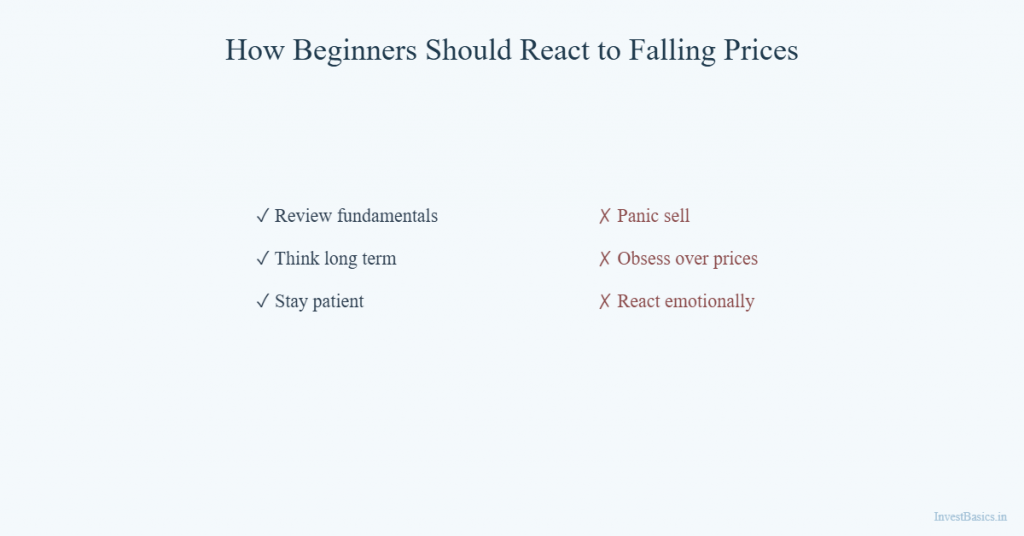
A calm, practical approach:
- Revisit why you invested and what was your target
- Check business fundamentals
- Think long term not short term
- Avoid impulsive decisions or reckless selling
If fundamentals are intact, patience is often rewarded here. So wait and watch becomes a best approach here.
Market Falls Are Part of Investing
Every long-term investor experiences:
- Temporary losses
- Market corrections
- Emotional discomfort
These are not signs of failure — they are part of the journey which every investor face.
The goal is not to avoid price falls, but to survive them intelligently.
Common Beginner Myths
Myth 1: Good companies never fall
Truth: Even the best companies face temporary declines.
Myth 2: Falling price means wrong decision
Truth: Short-term price moves don’t define investment quality.
Myth 3: Selling early avoids losses
Truth: Panic selling often locks losses.
Final Thoughts
Stock prices fall for many reasons — most of them temporary.
Understanding this helps beginners:
- Stay calm
- Avoid emotional mistakes
- Invest with confidence
Markets reward those who understand business value, not just price movement.