

Why This Question Matters in Real Life?
Many people start investing in mutual funds after hearing that they are “safe” or “better than fixed deposits.” For beginners, this can create a false sense of comfort. When the market goes down and the fund value drops, panic sets in. Understanding whether beginners can actually lose money in mutual funds is important because it helps you invest with the right expectations, not fear or overconfidence.
Can Beginners Actually Lose Money in Mutual Funds?
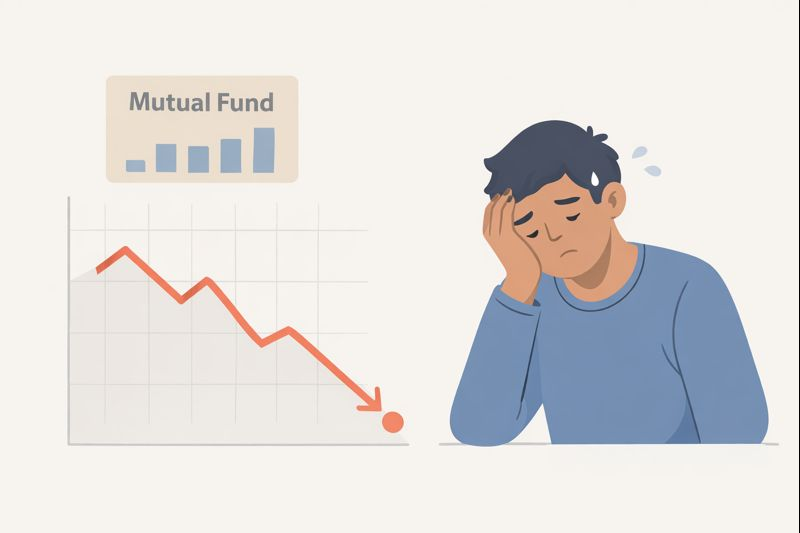
Yes, beginners can lose money in mutual funds, especially in the short term.
But this loss does not always happen because mutual funds are bad. It happens because of how and when beginners invest.
When we hear about mutual funds in India, it is often through success stories of people becoming “crorepatis” through a simple ₹5,000 monthly SIP. While those stories are inspiring, they don’t always mention the days when the market is “in the red”—meaning your investment value has actually dropped below what you put in.
Mutual funds invest in markets. Markets move up and down. When markets fall, the value of your mutual fund can also fall. If you sell at that time, you may book a loss.
This does not mean mutual funds are risky by default. It simply means they are not the same as savings accounts or fixed deposits.
Why Beginners Usually Lose Money (Not the Fund’s Fault)
Most losses happen due to common beginner mistakes, such as:
- Investing without understanding how mutual funds work
- Expecting quick profits
- Panicking during market falls
- Choosing the wrong type of fund for their goal
- Stopping SIPs when markets are down
These mistakes are more dangerous than market ups and downs.
A Simple Example
Imagine this situation:
You invest ₹10,000 in an equity mutual fund.
- After 6 months, due to a market fall, the value becomes ₹8,500
- You panic and withdraw the money
- You lose ₹1,500
Now imagine another scenario:
- You stay invested for 5 years
- The market recovers and grows
- Your ₹10,000 becomes ₹16,000 or more
The difference is time and patience, not luck.
Mutual Funds vs Fixed Deposits (What Beginners Should Know)
| Aspect | Mutual Funds | Fixed Deposits (FD) |
|---|---|---|
| Risk | Can go up and down | Very low |
| Returns | Higher over long term (not guaranteed) | Lower but stable |
| Short-term safety | Not ideal | Good |
| Long-term growth | Better potential | Limited |
| Best for | Wealth building | Capital protection |
Many beginners lose money because they treat mutual funds like FDs. They are not the same.
When Beginners Are More Likely to Lose Money
Beginners are more likely to lose money if they:
- Invest for short-term goals (less than 2–3 years)
- Choose equity funds without understanding risk
- Stop SIPs during market falls
- Invest based on tips or trends
- Check NAV daily and panic
Mutual funds reward discipline, not constant action.
How Beginners Can Reduce the Risk of Loss
Here’s what actually helps:
- Start with SIP, not lump sum
- Match fund type with goal duration
- Give investments time (especially equity funds)
- Avoid reacting to short-term market news
- Understand that temporary loss ≠ permanent loss
Loss becomes real only when you exit at the wrong time.
Is your money safer in some funds than others?
Not all mutual funds carry the same level of risk. In India, funds are categorized based on where they invest your money
| Type of Fund | Where it invests | Risk Level | Chance of seeing a loss |
| Equity Funds | Stocks of companies | High | High in the short term, but usually settles over 5-7 years. |
| Debt Funds | Govt bonds, Corporate loans | Low to Medium | Low, but can still happen if interest rates change or a company defaults. |
| Hybrid Funds | Mix of Stocks and Bonds | Moderate | Balanced; the “safe” part cushions the “risky” part. |
| Liquid Funds | Very short-term loans | Very Low | Almost negligible, but technically not zero. |
Practical Guidance for Beginners in India
- Use debt funds or liquid funds for short-term needs
- Use equity mutual funds only for long-term goals (5+ years)
- SIP is better for beginners than lump-sum investing
- Do not invest emergency money in mutual funds
- Treat market falls as normal, not as failure
Think of mutual funds as a journey, not a quick transaction.
Common Beginner Questions (FAQs)
Can I lose all my money in mutual funds?
In diversified mutual funds, losing all your money is extremely unlikely. Losses are usually partial and temporary, unless you invest without understanding risk.
Are SIPs safe for beginners?
SIPs are not risk-free, but they reduce timing risk and are easier for beginners to manage emotionally.
Is it better to wait for the “right time” to invest?
Most beginners fail at timing the market. Starting early and staying invested matters more.
Do mutual funds always give positive returns?
No. Returns depend on markets and time. Over long periods, good funds have historically performed better, but there are no guarantees.
Final Takeaway
Beginners do not lose money in mutual funds because mutual funds are bad.
They lose money because of impatience, wrong expectations, and poor decisions.
When used correctly, mutual funds can be a powerful tool for long-term wealth creation. The key is understanding risk, staying disciplined, and giving your investment enough time to work.