

In this article, we’ll clearly explain saving vs investing, how they are different, and why both are important for financial your security.
Many people use the words saving and investing as if they mean the same thing. In reality, they serve very different purposes. Saving helps you keep your money safe for short-term needs, while investing helps your money grow over time. Understanding the difference between saving and investing is important because choosing the wrong one at the wrong time can slow down your financial progress
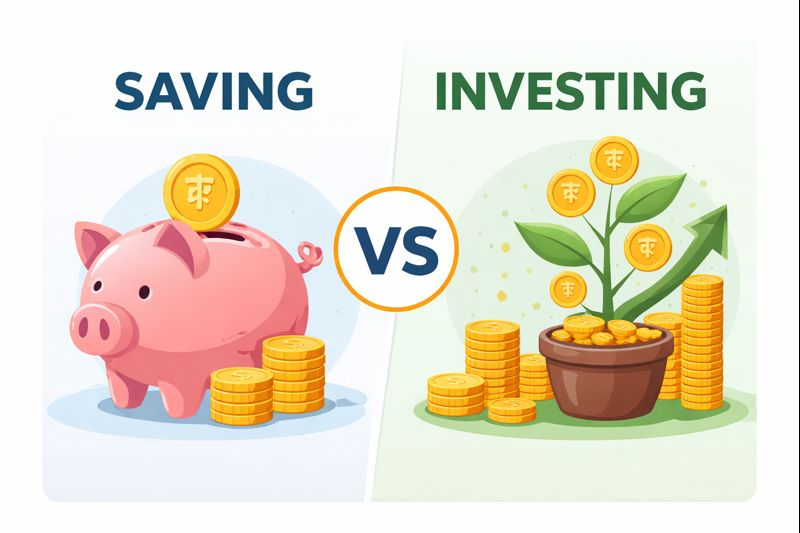
What Is Saving?
Saving means keeping money aside in a safe place for future use.
The main purpose of saving is protection and accessibility of your money, not growth.
Common saving options include:
- Savings bank account
- Fixed deposits (FDs)
- Recurring deposits (RDs)
Saving is usually:
- Low risk
- Easy to access
- Predictable
You know your money will be there when you need it. Also, you will get guaranteed rate of return.
What Is Investing?
Investing means putting your money into assets that have the potential to grow over time.
Unlike saving, investing involves some level of risk, but it also offers higher potential returns (returns are not guaranteed).
Common investing options include:
- Stocks (shares of companies)
- Mutual funds
- SIPs
- ETFs
The main goal of investing is long-term wealth creation.
Key Difference Between Saving and Investing
Here’s a simple comparison to make it clear:
Saving
- Very low risk
- Low returns
- Money is easily accessible
- Best for short-term needs
- Guaranteed returns
Investing
- Moderate to higher risk
- Higher potential returns
- Money grows over time
- Best for long-term goals
- Returns are not guaranteed
👉 Saving keeps your money safe.
Investing helps your money grow.
Why Saving Alone Is Not Enough
One major problem with only saving money is inflation.
Inflation means prices increase over time. What ₹100 can buy today may not buy the same things 10 years later.
If your savings grow at:
- 3–4% per year
but inflation is: - 5–6% per year
Then your money is losing value in real terms.
Example: right now you are able to buy 1 l of milk at a price of rs 60 per litre and next year the price will increase to 63 and next to that year 66 and so on. So to buy the same one litre of milk you are spending more this is called inflation.
This is why relying only on saving is risky for long-term goals.
Why Investing Is Necessary for Long-Term Goals
Long-term goals usually include:
- Retirement
- Children’s education
- Buying a house
- Financial independence
These goals need your money to grow faster than inflation.
Investing helps because:
- Returns compound over time
- Even small amounts grow significantly in the long run
- Time reduces risk
The earlier you start investing, the easier it becomes to achieve big goals with the power of compounding.
A Simple Real-Life Example
Let’s understand with a simple example.
Imagine you save 10,000 rupees every year in a savings account earning 3% interest.
Now imagine investing the same amount every year in a diversified mutual fund earning 10–12% over the long term.
After 15–20 years:
- Savings grow slowly
- Investments grow significantly due to compounding
This difference becomes huge over time, even though the yearly amount is the same & this way you are beating the inflation
Should You Save or Invest First?
The answer is both, but in the right order.
First, build savings for:
- Emergency fund (3–6 months of expenses) (should be in a fixed investment)
- Short-term needs
Once this is in place, start investing for:
- Long-term goals
- Wealth creation
Saving gives peace of mind.
Investing gives future security.
Saving vs Investing: Table Comparison
| Aspect | Saving | Investing |
|---|---|---|
| Purpose | To keep money safe | To grow money over time |
| Risk level | Very low or no risk | Medium to high risk |
| Returns | Low | Higher in the long term |
| Effect of inflation | Money may lose value | Helps beat inflation |
| Time horizon | Short-term goals | Long-term goals |
| Accessibility | Easy to withdraw anytime | May require staying invested |
| Examples | Savings account, fixed deposits | Mutual funds, stocks |
| Best used for | Emergency fund, near-term needs | Wealth creation, future goals |
Common Myths About Saving and Investing
Myth 1: Investing is too risky
Truth: Long-term, diversified investing reduces risk. Diversification means not putting your money in a single instrument.
Myth 2: I don’t earn enough to invest
Truth: You can start investing with small monthly amounts. Even with 500 rupees per month.
Myth 3: Saving is safer than investing
Truth: Saving is safer short-term, but risky long-term due to inflation.
How Beginners Should Think About Money
A healthy financial approach looks like this:
- Save for emergencies and short-term needs
- Invest for long-term goals
- Increase investments gradually as income grows
You don’t need to choose one over the other.
You need the right balance.
Final Thoughts
Saving and investing are not rivals.
They are partners.
Saving protects your present.
Investing secures your future.
Understanding the difference between the two is one of the most important steps in your financial journey.
Best practice to avoid investing through borrowed money for short gains as returns are not guaranteed and you may loose money.
🔑 Key Takeaway
Saving keeps you safe today.
Investing helps you grow tomorrow.
A strong financial plan needs both.
