
When you decide to start investing in the Indian share market, the first two words you’ll likely hear are “Demat Account” and “Trading Account.”
This often confuses beginners.
- Aren’t they the same?
- Why do we need two accounts?
- Can one work without the other?
In this article, we’ll clearly explain what a trading account & what is demat account is, how it works, and the difference between a Demat account and a trading account—in simple language.
Also read – What is Mutual Fund? | What is Investing? | What is demat account?
What Is Trading Account?
A trading account is an account that allows you to buy and sell shares securities on the stock market.
In simple words:
A trading account is the action account — it is used to place buy and sell orders.
If a Demat account is a storage locker, then a trading account is the door you use to enter and exit the market.
Why Do You Need a Trading Account?
You need a trading account to:
- Place buy orders for shares
- Sell shares you already own
- Trade ETFs, bonds, and other securities
Without a trading account:
- You cannot place orders on the stock exchange
- You cannot buy or sell shares, even if you have a Demat account
So, a trading account is mandatory for transactions.
How Trading Account and Demat Account Work Together
Both accounts work as a system.
Here’s the simple flow:
- You place a buy order using your trading account
- The trade is executed on the stock exchange
- Shares are credited to your Demat account
- When you place a sell order, shares are debited from Demat
- Money is credited to your bank account
You don’t manually move anything—the system does it automatically.
Trading Account vs Demat Account (Clear Comparison)
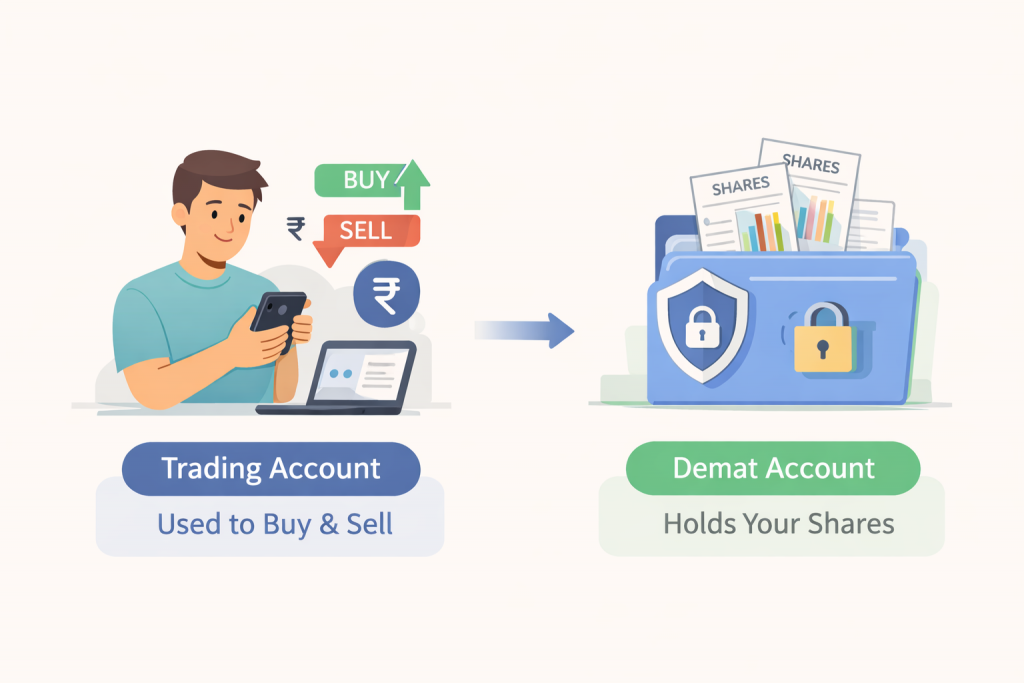
Demat Account
- Holds your investments
- Stores shares in electronic form
- Works like a digital locker
- Does not place orders
Trading Account
- Used to buy and sell securities
- Places orders on the stock exchange
- Does not store shares
👉 You need both to invest in the stock market.
Is a Trading Account Different from a Bank Account?
Yes, completely, both serve different purpose.
Bank Account
- Holds money
- Used for deposits and withdrawals
Trading Account
- Used only for buying and selling securities
- Linked to your Demat and bank account
Money flows from your bank account → through trading → investments go to Demat.
Who Provides Trading Accounts?
Trading accounts are provided by stock brokers. Many Indian brokers such as Zerodha and Groww offer Demat and trading accounts for retail investors.
Your broker:
- Gives you a trading platform (app or website)
- Connects your orders to the stock exchange
- Handles execution and settlement
Most brokers today offer:
- Trading + Demat + bank linking in one setup
What Can You Trade Using a Trading Account?
Using a trading account, you can:
- Buy and sell shares
- Trade ETFs
- Apply for IPOs
- Trade bonds and other securities
Some accounts also allow:
- Derivatives trading (for advanced users)
Beginners should focus on basic buying and selling, not complex trading.
Is a Trading Account Risky?
A trading account itself is not risky.
Risk comes from:
- Overtrading
- Emotional decisions
- Speculation without knowledge
For beginners:
- Fewer trades = better outcomes
- Long-term investing beats frequent trading
The account is just a tool—how you use it matters.
Charges Related to Trading Accounts
Depending on the broker, charges may include:
- Brokerage per trade
- Transaction charges
- Taxes and statutory fees
Many brokers now offer:
- Low brokerage
- Simple pricing
Always understand charges before you start trading.
Simple Real-Life Example
Suppose Harish wants to buy shares of a company.
- Share price: ₹200
- Quantity: 10 shares
- Total investment: ₹2,000
What happens?
- Harish uses his trading account to place the order
- ₹2,000 is deducted from his bank account
- 10 shares are credited to his Demat account
After 6 months, if he sells those shares at ₹250 each:
- Sale value = ₹2,500
- Profit (before charges and tax) = ₹500
- Money is credited back to his bank account
Demat vs Trading Account (Simple Comparison)
| Feature | Trading Account | Demat Account |
|---|---|---|
| Main purpose | Buy and sell shares | Hold shares safely |
| Works like | A transaction bridge | A digital locker |
| Used daily? | Yes, for placing orders | Only when shares change |
| Holds shares? | ❌ No | ✅ Yes |
| Needed for investing? | Yes | Yes |
| Can exist alone? | No | No |
👉 You usually open both together with a stockbroker.
Common Beginner Myths About Trading Accounts
Myth 1: Trading account is only for traders
Truth: Even long-term investors need trading accounts to buy/sell.
Myth 2: More trades mean more profits
Truth: Excessive trading often leads to losses and higher costs. Many beginners lose money by trading too often instead of investing patiently.
Myth 3: Trading account guarantees profits
Truth: Profits depend on investment decisions and market conditions, not on the account itself..
How Beginners Should Use a Trading Account
A healthy beginner approach:
- Use it mainly for long-term investing
- Avoid frequent buying and selling
- Don’t react to daily market noise and rumors
- Focus on learning before acting
Your goal should be disciplined investing, not constant trading.
👉Read Stock market basics with us.
Final Thoughts
A trading account is your gateway to the stock market.
It:
- Allows buying and selling
- Works together with Demat and bank accounts
- Makes investing possible
Once you understand the role of a trading account, the investing process feels clear and structured.
🔑 Key Takeaway
Trading account places orders.
Demat account stores investments.
Both are essential for stock market investing.