
If you want to invest in shares or mutual funds, one term you’ll hear this term called Demat account.
Many people wants to invest in shares but they stop because they do not understanding of Demat account. You may feel confused and ask:
- What exactly is a Demat account?
- Is it the same as a bank account?
- Why is it compulsory?
In this article, you’ll clearly understand what a Demat account is, how it works, and why it is essential for investing—in simple language.
What Is a Demat Account?
A Demat account is an account that holds your shares and securities in electronic (digital) form. (short form of Dematerialized)
Earlier, shares used to exist as paper certificates. Today, all shares are stored digitally in a Demat account -same like money is stored digitally in a bank account. However, instead of tracking rupees it tracks no. of shares in your account and their prices.
In simple words:
A Demat account is a digital locker for your investments & it works as a storage for your securities.
Your shares are kept electronically in demat account.
You do not receive any Paper share certificates.
Also read –
What is stock market?
What is Trading account?
Why Was the Demat System Introduced?
Paper-based share certificates caused many problems:
- Prevent Loss or damage of shares certificates
- Prevent Forgery and fraud
- Prevent Slow transfer process
- Prevent High paperwork
The Demat system was introduced to:
- Make investing safer
- Speed up transactions
- Reduce paperwork
- Improve transparency
Today, Demat accounts are mandatory for stock market investing in India.
What Can You Hold in a Demat Account?
A Demat account can hold:
- Shares (stocks)
- Mutual fund units
- Bonds and debentures
- ETFs
- Government securities
All these investments stay in electronic form, visible in one place.
How Is a Demat Account Different from a Bank Account?
This is a very common beginner confusion and often people get confused here between bank and demat account.
Bank Account
- Holds money
- Used for deposits and withdrawals
- Managed by banks
Demat Account
- Holds investments (shares, funds, bonds)
- Used for buying and selling securities (shares, bonds, etc..)
- Managed by depositories through brokers
Both accounts work together but serve different purposes. Bank account keeps your money and demat account keeps your securities (stocks, bond etc.) When you sell any stock from your demat account the money can be transferred to your bank account.
How Does a Demat Account Work?
Here’s a simple flow:
- You place a buy order using a trading account
- Shares are purchased from the market
- Shares are credited to your Demat account
- When you sell, shares are debited from Demat
- Money is credited to your bank account
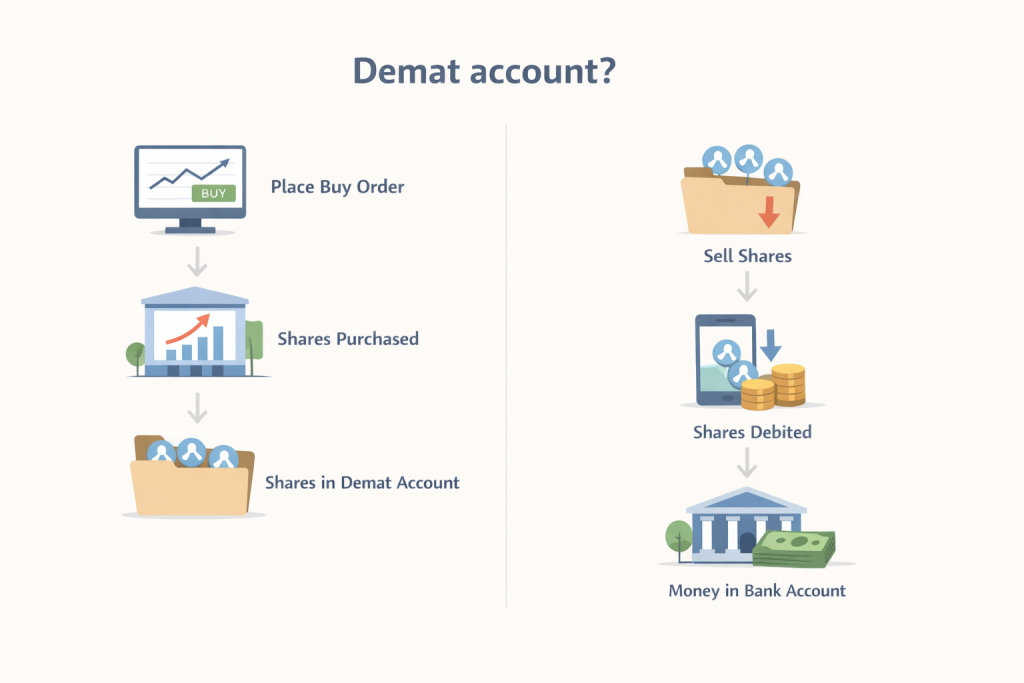
You don’t need to manually move anything—everything happens automatically.
Who Provides Demat Accounts?
Demat accounts are provided through stock brokers, who act as intermediaries. (Examples of those brokers Zerodha, Groww, Upstocks etc.)
Behind the scenes, shares are stored with depositories such as:
- NSDL (National Securities Depository Limited)
- CDSL (Central Depository Services Limited)
As a user, you don’t deal with depositories directly—your broker manages that for you. These depositories function as digital banks in order to safeguard investor’s securities like stocks and bonds in electronic form.
Is a Demat Account Mandatory?
Yes.
If you want to:
- Buy or sell shares
- Invest in ETFs
- Apply for IPOs
You must have a Demat account. Without it, stock market investing is not possible.
Is a Demat Account Risky?
A Demat account itself is not risky.
Risks come from:
- What you invest in
- Market movements
- Emotional decisions
Demat accounts are:
- Regulated
- Secure
- Protected by strict rules
Your investments are safe as long as you use trusted brokers and follow basic security practices. When you buy and sell anything from your demat account you should do proper research before that.
Charges Associated with Demat Accounts
Depending on the broker, there may be:
- Account opening charges (often zero with some brokers)
- Annual maintenance charges (AMC)
- Transaction charges (based on your trade)
Many brokers today offer low-cost or zero-cost Demat accounts.
Always read charges before opening an account.
How Beginners Should Use a Demat Account
A healthy beginner approach:
- Use Demat account for long-term investing
- Start with 1 demat account instead of opening many at once
- Avoid frequent buying and selling
- Focus on learning, not constant action
A Demat account is a tool – not a shortcut to earn quicker money.
Demat account vs Trading account
| Feature | Demat Account | Trading Account |
|---|
| Main role | Holds shares | Buys and sells shares |
| Works like | Digital locker | Transaction tool |
| Stores investments | Yes | No |
| Required for investing | Yes | Yes |
Final Thoughts
A Demat account is the foundation of modern investing.
It:
- Stores your investments safely
- Enables quick buying and selling
- Removes paperwork and fraud risks
- It doesn’t generate profit on its own
Once you understand what a Demat account does, investing becomes simpler and less intimidating.
What to Read Next
👉 What Is a Trading Account? Demat vs Trading Explained
🔑 Key Takeaway
A Demat account stores your investments digitally.
It is mandatory for stock market investing.
Safety comes from understanding, not avoiding investing.