

When you withdraw money from a mutual fund, the fund may charge a small exit fee. This charge is called the exit load in mutual fund.
However, exit load is not applied to every withdrawal. It depends on how long you stay invested. Below, we will understand when exit load applies and when it does not.
Why this matters in real life
When you invest in a mutual fund, you will think about returns and how long you should stay invested. But many investors miss one small thing that can quietly reduce their money when they withdraw — the exit load in mutual fund.
If you are a beginner, understanding this can save you from unnecessary charges and disappointment later.
What does exit load in mutual fund mean?
An exit load in mutual fund is a small fee (usually around 1%) charged by the fund company when you take your money out before a certain time period.
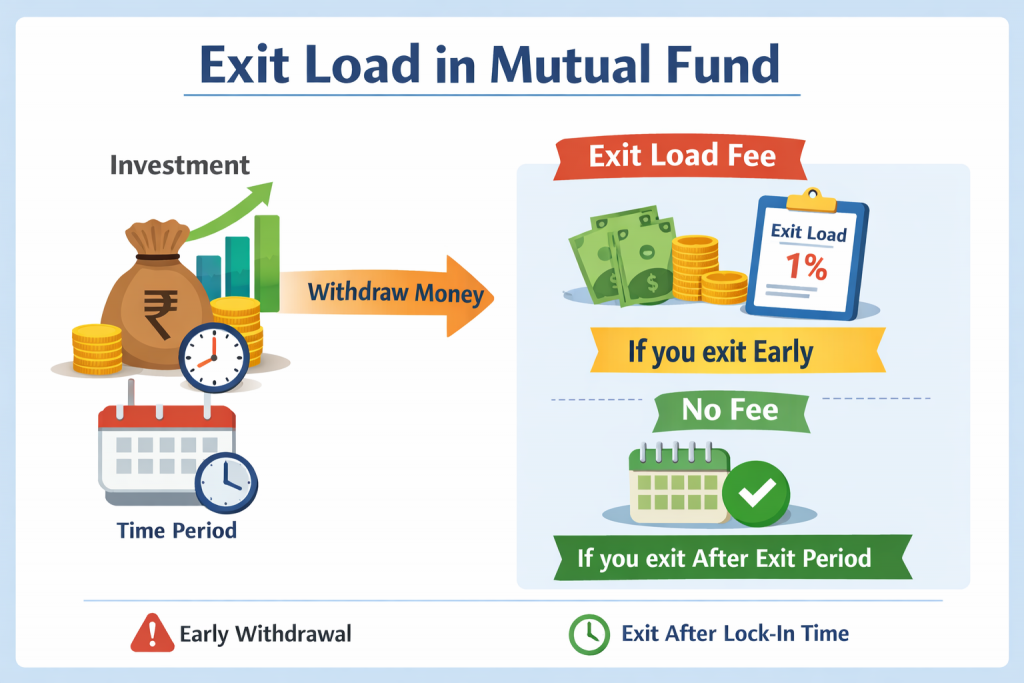
Think of it like this:
If you book a train ticket and cancel it at the last moment, the railway keeps a small cancellation charge. Exit load works in a similar way.
Not all mutual funds have exit load, and even when they do, it applies only if you exit early.
Why do mutual funds charge exit load?
Exit load exists mainly for two reasons:
- To discourage short-term withdrawals
Mutual funds are designed for investing, not frequent in-and-out trading. - To protect long-term investors
When many investors exit suddenly, the fund manager may be forced to sell assets at the wrong time. Exit load helps reduce this behaviour.
Important point:
👉 Exit load is not a penalty, it can be considered more like a discipline tool.
A real-life example
Let’s say you invest ₹1,00,000 in an equity mutual fund.
- Exit load: 1% if redeemed within 1 year
- You withdraw the full amount after 6 months
- Value of your investment at that time: ₹1,05,000
Now the calculation:
- Exit load = 1% of ₹1,05,000 = ₹1,050
- Amount you actually receive = ₹1,03,950
If you had waited until the exit load period was over, you would have received the full ₹1,05,000. If you want to calculate the return on your Mutual funds use our SIP Calculator and Lumpsum Calculator.
Exit load in mutual fund vs no exit load in mutual fund comparison
This table will explain what happens when you purchase mutual funds which has Exit load and other one which has no exit load.
| Situation | With Exit Load | Without Exit Load |
|---|---|---|
| Withdraw early | Small charge applies | No charge |
| Encourages staying invested | Yes | Not really |
| Common in | Equity funds | Liquid funds, some debt funds |
| Good for beginners | Yes, if you plan long term | Yes, for emergency money |
Do all mutual funds have exit load?
No. Exit load depends on the type of mutual fund.
- Equity mutual funds: Usually have exit load (often 1% for 1 year)
- ELSS funds: No exit load, but they have a lock-in of 3 years
- Liquid funds: Mostly no exit load (or very small for a few days)
- Debt funds: Depends on the scheme
Always check the scheme details before investing. If you want to how long mutual fund redemption take read our complete guide.
When beginners should care about exit load?
You should pay attention to exit load in mutual fund if:
- You may need the money in the short term
- You are investing without an emergency fund
- You plan to test the market for a few months
If your goal is long-term (5+ years), exit load usually doesn’t matter much.
Practical tips for beginners
- If you need money within 6–12 months, avoid equity funds with exit load
- For emergency money, prefer liquid funds or savings accounts
- Read the exit load section before investing — it’s usually just 1–2 lines
- Don’t exit just because the market falls for a few weeks
- Align your investment with your goal duration
Common questions beginners ask (FAQs)
Is exit load charged on SIP investments too?
Yes. Each SIP installment is treated separately. Exit load applies based on the date of each installment
Is exit load deducted from my bank account?
No. It is adjusted before the money reaches your bank. You will receive the net amount.
Can exit load change later?
Existing investments usually follow the exit load mentioned at the time of investment. New investments may follow updated rules.
Is exit load the same as tax?
No. Exit load is a fund charge. Tax (like capital gains tax) is separate and handled differently.
How can I avoid exit load completely?
By staying invested beyond the exit load period or choosing funds that do not have exit load
Final takeaway
Exit load is not something to fear, but something to understand before investing. Once you plan your investment horizon properly, exit load in mutual fund becomes irrelevant for long-term investors.
A little awareness at the start can prevent unnecessary deductions later. If you want to know What is AUM in mutual funds? read our full article.
Disclaimer: This article is for educational purposes only.
