


NAV stands from Net Assets Value. In this article we will understand what is NAV & how it is calculated?
Why this matters in real life
When you invest in a mutual fund, you often hear people say, “NAV went up” or “NAV is down today.” Many beginners assume NAV is like a share price and feel confused about what it actually means.
Understanding how mutual fund NAV is calculated helps you know what your investment is really worth and why the value changes from day to day.
What is NAV in simple words?
NAV stands for Net Asset Value.
In plain language, NAV tells you the per-unit value of a mutual fund.
If a mutual fund owns shares, bonds, or other investments, NAV shows how much each unit of the fund is worth after adjusting for expenses.
You don’t buy a mutual fund by looking at “cheap” or “expensive” NAV. What matters is how the fund grows over time, not the NAV number itself.
How mutual fund NAV is calculated
The calculation is straightforward once you break it down.
The basic idea
A mutual fund first finds out:
- Total value of all investments it holds
- Total expenses and liabilities
- Total number of units held by investors
Then it uses this simple method.
NAV calculation method – How mutual fund NAV is calculated
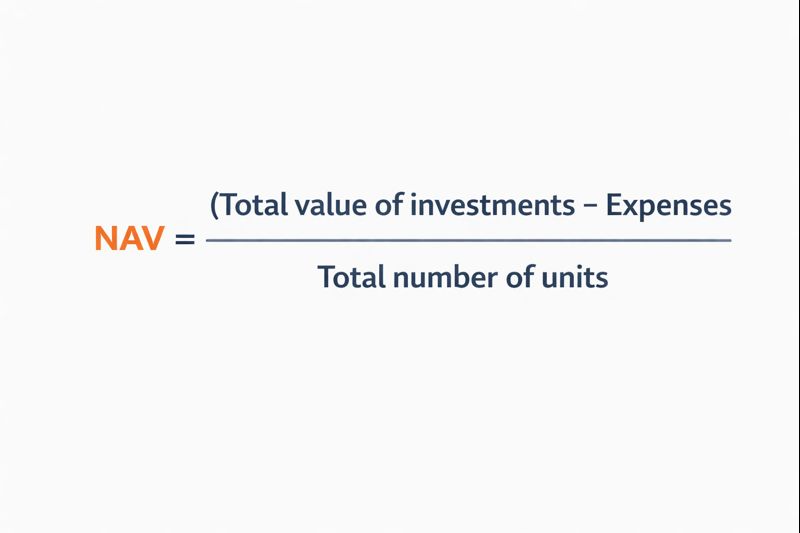
NAV = (Total value of investments − Expenses) ÷ Total number of units
That’s it. No complicated maths.
Real-life example
Let’s say a mutual fund has:
- Shares and bonds worth ₹100 crore
- Expenses and liabilities of ₹2 crore
- Total units issued: 9.8 crore units
Now calculate:
- Net assets = ₹100 crore − ₹2 crore = ₹98 crore
- NAV = ₹98 crore ÷ 9.8 crore units
- NAV = ₹10 per unit
If tomorrow the value of investments rises, the NAV will go up. If markets fall, the NAV will come down.
When and how NAV changes
NAV is calculated once every business day after markets close.
- If the stock market goes up → NAV usually increases
- If the stock market falls → NAV usually decreases
- On weekends and holidays → NAV does not change
This is why today’s investment is always allotted at the NAV of that day, not the moment you place the order.
NAV vs share price comparison
| Point | Mutual Fund NAV | Share Price |
|---|---|---|
| Who decides the value | Based on fund assets | Market demand & supply |
| Changes during the day | No | Yes |
| Calculation | Formula-based | Market-driven |
| Cheap vs expensive | Not relevant | Often compared |
This is why a mutual fund with NAV ₹20 is not “better” or “worse” than one with NAV ₹100.
How you should use NAV practically
Here’s how you should think about NAV
- Don’t choose funds just because NAV looks low
- Focus on long-term performance and consistency
- Understand that NAV reflects market movement, not fund quality
- For SIPs, NAV matters less because you invest regularly at different values
- Check NAV mainly to track progress, not to time entries
NAV is a measurement tool, not a decision-maker.
Frequently Asked Questions (FAQs)
Is NAV the price I pay when investing?
Yes. When you invest in a mutual fund, units are allotted based on that day’s NAV.
Can NAV become zero?
No. NAV changes with market value, but it does not become zero unless the fund shuts down completely.
Is higher NAV better than lower NAV?
No. A higher NAV does not mean better returns. Returns depend on growth, not the NAV number.
Does NAV include fund expenses?
Yes. All regular expenses are already adjusted before NAV is calculated.
Is NAV same for SIP and lump sum?
Yes. The NAV is the same for everyone on that day, whether you invest through SIP or lump sum.
Final takeaway
Now you know how mutual fund NAV is calculated and why it changes daily. NAV simply reflects the value of what the fund owns, divided among investors. Once you understand this, you stop worrying about daily NAV movement and focus more on your long-term goals.
